Tuesday, February 7, 2012

Tuesday, January 31, 2012
perfect competition
perfect competition
| The assumptions of perfect competitions | - the industry is made of a very large nmber of firms - each firm is so small that they have no effect on the market if they change output - all the firms produce homogenous products - firms are completly free to enter and leave the market as they choose. -all producers and consumers have perfect knowledge of the market Good example is agricultural | |
| Profit maximimization | | |
Possible short run profit and loss | Short run abnornmal profits  Short run losses
| |
| Short run abnormal profits to long run norma
| | |
| Short run losses to long run normal profits
| | |
| Long run equilibrium in perfect competion
| | |
| Productive and allocative efficiency in perfect competition
| | |
| Allocative efficiency
•Allocative efficiency (the socially optimal level of output) occurs where suppliers are producing the optimal mix of goods and services required by consumers. •Price reflects the value that consumers place on a good and is shown on the demand curve (average revenue) •Marginal cost reflects the cost to society of all the resources used in producing an extra unit of a good, including the normal profit required for a firm to stay in business. •Allocative efficiency occurs where marginal cost (the cost of producing one more unit) is equal to average revenue (the price received for a unit). •MC=AR [allocatively efficient (socially optimal) level of output] | | |
| Productiove and allocative effeciency in the short run in perfect competition | | |
| Productive and allocative efficiency in the long run in perfect competion | | |
| |


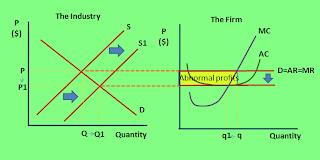 l profits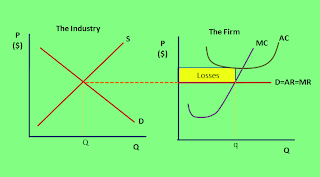


Monday, January 30, 2012
Exercises for costs of prod.
1.
0 0 - -
1 120 120 120
2 300 150 180
3 500 166 200
4 640 160 140
5 675 135 35
6 710 118 0
2. As more variable resources are added more products are made up until the point where their averafe decreases and even further where less products are made
3. Variable
Fixed
Ficed
Variable
Fixed
Variable
Variable
Variable
Fixed
Variable
4.
500 - - - -
1 500 20 520 500 20
2 500 100 300 250 50
3 500 400 300 166 133
4 500 1100 400 125 275
5. A. yes it is constant
b. yes the law holds.
6.
7. They take the tangent of all the infinite curves
8. Economies of scale happen when-
a. Companies get so large they get discounts on a variety of things such as advertizing, bulk buying of materials and shipping
b. Diseconomies happen when there is a lacka of management and alienation
9. They don’t have their own transportation, little money to spend on advertizing and usually an ineffective production line
10. From 1, 150, 150, 150, 280, 130, 140, 130, 390, 130, etc. (if u actually want to see this, ask me)
11. -30
49*20
50*20
1000*0.05=50
1000-50=950
950-980=-30
12. Because they are covering all their costs even the opp. Cost
13. 1. Investing, 2. Financial 3.normal 4. Sacrifice 5. 15 percent 6. Opp.cost 7. Super normal
14. 1. Management 2. Information 3. 4. Targets 5. Satisficing 6. Growth 7. Management 8. Economies 9. Pricing 10. Share 11. Stake holders 12. Profits 13. Csr
15. Baumol wants to have the most sales and increase revenue but doesn’t think about profits whilst marris, wants to grow as a firm thus making more money in the future. Simon wants to satifice meaning that he wants to cover his costs but not much more
16. Because csr is good advertizing.
warm up on perfect competition
Warm up
| | Number of firms | Market power | Level of differentiation | Barriers to entry | Examples |
| Perfect composition | Infinite | none | Homogenous | No | Agricultural |
| Monopolistic competition | many | small | Lots- differentiate | Small | Clothing |
| oligopoly | 3-4 (70 %) | Quite large | Maybe- homogenous or heterogeneous products | Very hard | Oil/cereal |
| monopoly | 1 | 100% | None | Virtually impossible | EDF (Energy of france) |
Sunday, January 29, 2012
Exercises
12. Mr=0
13. Because at one unit there would be a 400 dollar difference between selling one unit and 0 units but from there it starts decreasing.
14. because once the firm has reached less than mr=0 then the mr would start to decrease and the firm would stop maximizing profit.
15. a. at a output of 5
b. 45 dollars
c. 4 output
d. 8 output
16.
17. This is because since the price does not get higher the output stays constant making the revenue stay constant, meaning there would be no change in MR
18. a. at 4 output
b. 815 dollar
c.
d. at 8
19.
20.
21.
Thursday, January 26, 2012
revenue and profitz
| Revenue | Revenue is the income that a firm receives from selling its products, goods and services, over a certain time period. (TR)- is the total amount of money that a firm receives from selling its products (ar)- is the revenue that a firm receives per unit of its sales. (MR)- is the extra revenue that a firm gains when it sells one more unit of a product in a given time period. |
| Basics |
|
Revenue and profit theory
| Economists & Accountants | Profit = Total revenue minus total costs To an accountant total costs = fixed + variable cost Economic cost=explicit fixed costs + explicit variable costs +implicit costs |
| Profits | total revenue=total cost----- breaking even total revenue more then total cost----- profit total revenue less than total cost ----- making losses |
| Shut down price | The shut-down price is the level of price that enables a firm to cover its variable cost in the short run. Shut down price = P = AVC P less than AVC |
| Break even cost | The price at which a firm is able to make a normal profit in the long run. This means it will break even, covering all its cost, including opportunity cost (normal profit). Break even price = P = ATC |
| General graphs |
|
| The profit maximizing level of output | Mr=mc Tells the firm at which level of ouput produces the most profit
|
| Firms and maximizing profit | • Revenue maximization: Entrepreneurs often measure success by the amount of revenue they make. • Growth Maximization: companies may set their target to achieve growth in the short run, rather than profits, in order to gain a large market share and then dominate the market in the long run. • Satisficing: They claim that what entrepreneurs do is “satisifice” (work hard enough to make a reasonable living [cover opportunity cost] but in most cases don’t push themselves further. • Corporate social responsibility (CSR): this is where a business includes “public interest” in it’s decision making. – Attract and keep a better workforce – Build reputation and develop brand loyalty – Reduce the need for government intervention in business activities. bad – Some adopt CSR approach to take attention away from their main (demerit) good products. |
| | |


Monday, January 16, 2012
cost-
| Short run and long run | Short run- period of time in which at least 1 factor is fixed all production takes place in the short runt Long run- the long run is the period of time in which all factors are changed but the state of production is fixed |
| Total average and marginal product | Total product is the total output that a firm produces . Average product is the output that is produced on average by each unit of the variablle factor Ap= tp/v Marginal proudct is the extra outpuut that is produced by using an extra unit of the variable factor |
| The law of diminishing returns | The hypothesis of eventually diminishing marginal returns- As extra units of a variable factor are added to a given quantity of a fixed unit of the variable factor will eventually diminish The hypothesis of eventually diminshing average returns- as extra units of a variable factors are added to a given quantity of a fixed factor, the output per unit of the variable facto will eventually diminish. |
| Economic cost | Econoimic cost is the oppurtunity cost of the firms production 1. factors that are purchased from others and not already owned by the firm- getting a worker and paying 1000$ cost is the 1000$ and everything that 1000$ could be used on 2. factors that are already owned by the firm- implicit costs- the earnings that a firm could have had if it had emplyed its factors in another use or if it had hired out- An owner of a firm could make 100 $ working somewhere else as a tax collecter, has to reach that and + or selse he will take that job instead and the shop will close. |
| Short run costs- | Firms have certain costs 1. Total costs-total costs is the complete cost pf producing output Total fixed costs- the costs of the fixed assets Total variable costs- total costs of the variable assets Total costs-tfc plus tvc 2. average fixed costs- the fixed costs per unit of output average variable costs- the variable costs per unit of output average total cost- the total cost per unit of output 3. marginal cost- mc is the increase in total cost of producing an extra unit of output |
| The long run | • We have already said that the long run is the planning stage and the entrepreneur is free to adjust the quantity of all factors of production and is only restrained by the level of technology. • The long-run average cost curve [LRAC] in theory is an “envelope curve,” it envelopes an infinite number of short-run average cost [SRAC] curves. |
| Economies of Scale | • Explains the down sloping part of the long-run ATC curve. • Scale increases, will for a time lead to lower average cost of production. As economies get bigger they will benifit through specification- workers will specify thus work better Division of later-repititive and effecient Bulk bying- discounts given Transport economies- with bul transporting prices go down Large machines- they can buy their own machines Promotional- advertizing |
| Diseconomies | When a firm becomes to large problems may arise 1. Control and communication problems- the larger a firm is the harder it is for management to coordinate production and communicate effectively. Both lead to inefficiency (and increased costs per unit output). 2. Alienation and loss of identity- As firms grow both workers and managers may begin to feel they are only a very small part of a very large organization; they start to think what they do doesn’t matter and they lose a sese of belonging and loyalty . As this happens they become less productive forcing up the per unit cost |
| External economies and diseconomies of scale | • +Example- A firm grows large so colleges in the area start teaching the skills necessary to perform in the industry; lowering LRAC costs to the firm with a better educated workforce. - Competition among individual firms cause the cost of labor, capital and raw materials to go up. |
| | • |
Subscribe to:
Posts (Atom)